Introduction
Cardano Addresses








Overview
This module provides mnemonic (backup phrase) creation, and conversion of a mnemonic to seed for wallet restoration, and address derivation functionalities.
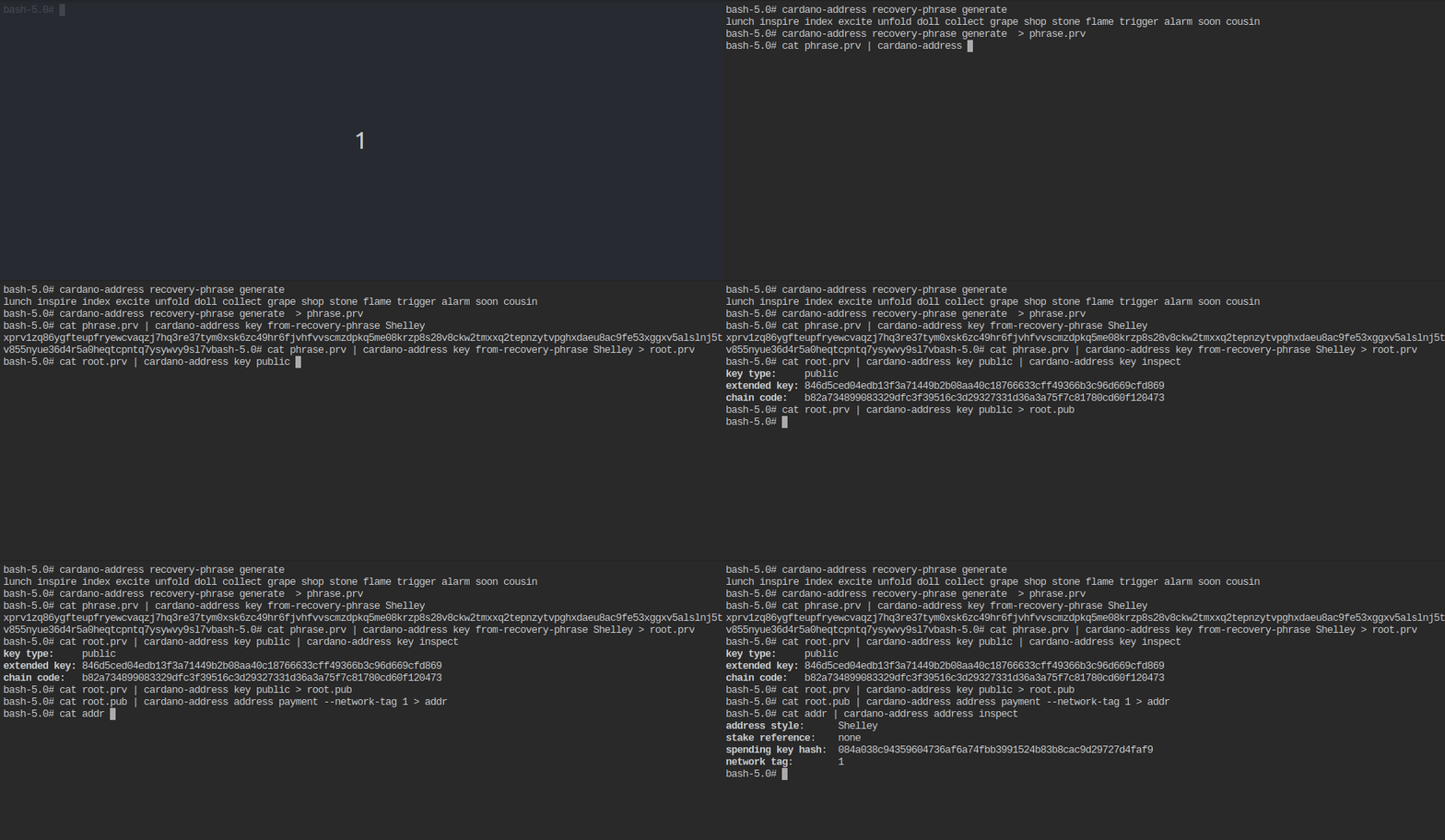
Feature overview
cardano-addresses ships a Haskell library and a cardano-address CLI that cover
the whole lifecycle of Cardano wallet keys and addresses — from a human-readable
recovery phrase to a spendable on-chain address.
| Capability | What it provides |
|---|---|
| Recovery phrases | Generate BIP-0039 mnemonics of any multiple of 3 words (9–24) in English, Italian, French, Spanish, Japanese or Korean, and turn them back into keys. |
| Key derivation | Convert a recovery phrase into an extended root private key for the Shelley, Shared, Byron or Icarus styles, then derive child keys along CIP-1852 / CIP-1854 / CIP-1855 paths such as 1852H/1815H/0H/0/0 (hardened indexes accept the legacy H or the standard ' suffix). |
| Key handling | Produce extended and non-extended signing/verification keys, extract the signing key or chain code, hash public keys (--cip-0105), inspect keys, and compute cardano-wallet-compatible wallet IDs. |
| Address construction | Build payment, stake, delegation (base), pointer and legacy bootstrap (Byron/Icarus) addresses from key hashes or scripts, for any network tag. |
| Address inspection | Decode any address into its style, type, network tag and spending/stake credentials. |
| Native scripts | Express all / any / at_least N multi-signature scripts with active_from / active_until timelocks, then hash, validate or compute their preimages (the script may be given as an argument or read from stdin). |
| Governance | Derive DRep and Constitutional Committee (cold/hot) keys together with their CIP-0129 credentials and scripts. |
| Input encodings | Keys, key hashes, script hashes and addresses are read in bech32 (the native format), as well as raw base16 and, where unambiguous, base58. |
| Interoperability | Round-trip keys, hashes and CBOR hex with cardano-cli, and pipe any output through bech32 for hex encoding. |
| WebAssembly | A single cardano-addresses.wasm binary (GHC WASM backend) runs address inspection, key derivation, address construction and Ed25519 signing/verification in the browser or any WASI runtime. |
The functionality is exposed through four CLI command groups:
recovery-phrase— generate and work with recovery phrases.key— create, derive, inspect and hash keys.address— create and inspect addresses.script— create, hash, validate and inspect scripts.
Proving ownership of a Cardano key with a zero-knowledge proof (experimental) is documented on the ownership proving using ZKP page.
Documentation
Command-Line
Supported platforms
cardano-addresses is officially supported on the following operating systems:
- Linux - Ubuntu 20.04+, Debian 11+, Fedora 38+, and other major distributions
- macOS - version 11 (Big Sur) and later
- Windows - Windows 10 and Windows 11
cardano-addresses comes with CLI for Linux, MacOS and Windows. See releases to get respective pre-compiled binaries. There is also straightforward way to build Docker image. The command-line is self explanatory by using --help on various commands and sub-commands.
💡 Most commands read argument from the standard input. This prevent sensitive information from appearing into your shell history and, makes it easy to pipe commands!
Building/testing from source using nix
Prerequisites: Install Nix with flakes enabled.
Enter development shell
nix develop
Inside the development shell:
# building
cabal build all

# testing
cabal test cardano-addresses:unit

# installing executable locally
cabal install cardano-address
Build using nix directly
# Build the Linux x86_64 binary
nix build .

# Run the built binary
./result/bin/cardano-address
Building for different platforms
# Linux x86_64
nix build .

# Darwin x86_64
nix build .#packages.x86_64-darwin.default

# Darwin aarch64 (Apple Silicon)
nix build .#packages.aarch64-darwin.default

# Linux aarch64
nix build .#packages.aarch64-linux.default

# Linux x86_64 to Windows (cross-compilation)
nix build .#packages.x86_64-linux.default
Building the Docker image
nix build .#packages.x86_64-linux.docker-image
docker load < result
Override command for cross-compilation
We have now fixed cross-compilation (from Linux to Windows) by replacing runtime git call in System.Git.TH with CPP macro (ie., GITREV) defaulting to "unknown" but allowing overriding via -DGITREV as below:
cabal build all --ghc-option=-DGITREV=\"$(git rev-parse HEAD)\"
Preparation steps before uploading to hackage
cabal build all
cabal haddock
cabal sdist
Note: Make sure proper version is set in cardano-addresses.cabal
Docker Image
Please make sure you have just installed as justfile is used for building Docker image.
Build
just clean-build-docker
Run
Use the auto-remove flag --rm when running commands.
docker run --rm cardano-address recovery-phrase generate --size 15
Use the interactive flag -i when piping stdin:
echo "addr1gqtnpvdhqrtpd4g424fcaq7k0ufuzyadt7djygf8qdyzevuph3wczvf2dwyx5u" | docker run --rm -i cardano-addresses address inspect
Javascript support
Javascript support was discontinued and dropped. One could look at the following now:
Alternatively one could lean back on release 3.9.0 where Javascript was still present.
WebAssembly
The library compiles to WebAssembly via GHC's WASM backend, producing a single cardano-addresses.wasm binary that runs in the browser or any WASI runtime.
Build
nix build github:IntersectMBO/cardano-addresses#wasm
ls result/cardano-addresses.wasm   # 7.0MB
Commands
The binary reads JSON from stdin and writes JSON to stdout. A cmd field selects the operation:
# Address inspection
echo '{"cmd":"inspect","address":"addr1..."}' | wasmtime result/cardano-addresses.wasm

# Key derivation (CIP-1852 Shelley)
# Hardened indexes can use the legacy 'H' suffix or the standard single-quote (') suffix.
# An optional 'm/' prefix denotes absolute derivation from the master key.
echo '{"cmd":"derive","mnemonic":"word1 word2 ...","path":"1852H/1815H/0H/0/0"}' | wasmtime result/cardano-addresses.wasm
# Equivalent with standard notation:
# echo '{"cmd":"derive","mnemonic":"word1 word2 ...","path":"m/1852'/1815'/0'/2/0"}' | wasmtime result/cardano-addresses.wasm

# Address construction
echo '{"cmd":"make-address","type":"enterprise","network":"testnet","payment_key":"hex..."}' | wasmtime result/cardano-addresses.wasm

# Ed25519 signing and verification
echo '{"cmd":"sign","key":"hex...","message":"hex..."}' | wasmtime result/cardano-addresses.wasm
echo '{"cmd":"verify","key":"hex...","message":"hex...","signature":"hex..."}' | wasmtime result/cardano-addresses.wasm

# Legacy bootstrap addresses (Byron/Icarus)
echo '{"cmd":"bootstrap-address","style":"icarus-from-mnemonic","protocol_magic":764824073,...}' | wasmtime result/cardano-addresses.wasm
Browser integration
Use @bjorn3/browser_wasi_shim to run the WASM binary client-side:
import { WASI, File, OpenFile, ConsoleStdout } from "@bjorn3/browser_wasi_shim";

const mod = await WebAssembly.compile(await (await fetch("cardano-addresses.wasm")).arrayBuffer());

async function call(input) {
  let out = "";
  const fds = [
    new OpenFile(new File(new TextEncoder().encode(input))),
    ConsoleStdout.lineBuffered(l => out += l + "\n"),
    ConsoleStdout.lineBuffered(() => {}),
  ];
  const wasi = new WASI([], [], fds, { debug: false });
  wasi.start(await WebAssembly.instantiate(mod, { wasi_snapshot_preview1: wasi.wasiImport }));
  return JSON.parse(out.trim());
}
Benchmarked: ~9ms compile (one-time), ~3ms per Shelley call, ~13ms for legacy.
A live demo is available at: https://IntersectMBO.github.io/cardano-addresses/browser/
Nix integration
Downstream flakes consume the WASM as a package:
{
  inputs.cardano-addresses.url = "github:IntersectMBO/cardano-addresses";

  outputs = { cardano-addresses, ... }: {
    packages.wasm = cardano-addresses.packages.x86_64-linux.wasm;
    # result/cardano-addresses.wasm
  };
}
Contributing
Pull requests are welcome.
When creating a pull request, please make sure that your code adheres to our coding standards.